


Can Readers Trust AI-Written Content? – Impact on Credibility and Engagement
 Posted by
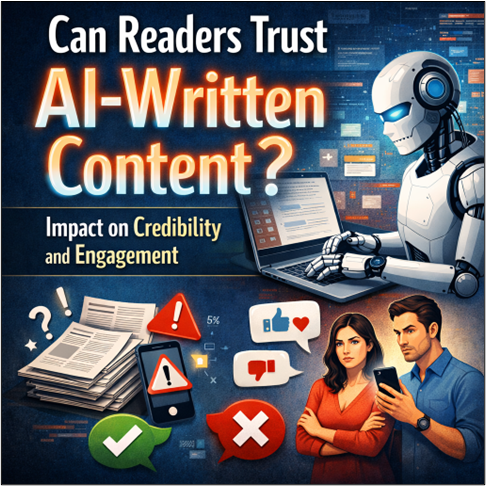
In 2026, AI writing tools are no longer a novelty. They generate news briefs, marketing blogs, product descriptions, and even opinion-style articles in seconds. For readers, this raises a deeper question than speed or convenience—can machine-written words be trusted?
The answer, shaped by recent research and public reaction, is cautious rather than confident. While AI expands access to information and improves efficiency, it also unsettles long-standing assumptions about credibility, authorship, and accountability. The tension between usefulness and trust now defines how audiences engage with AI-generated content.
A Public That Wants Clarity but Lacks Control
One of the clearest signals from recent studies is that readers care deeply about knowing who or what created the content they consume. A 2025 Pew Research survey found that more than three-quarters of respondents consider it important to distinguish AI-written content from human-written work. At the same time, over half admitted they cannot reliably tell the difference.
This gap creates unease.
When people feel unable to assess authorship, they grow suspicious of intent. Concerns about misinformation intensify this reaction. More than half of respondents in the same study rated AI’s societal risks as high, particularly in areas tied to news, education, and public opinion. The issue is not that AI exists. It is that readers feel they are losing agency in evaluating what they read.
This discomfort is not limited to one region or demographic. International surveys echo the same pattern—acceptance of AI for technical or background tasks, resistance when AI moves closer to interpretation, judgment, or storytelling. The closer content feels to human expression, the higher the expectations for accountability.
When AI Gets It Wrong
AI systems speak with confidence, even when they are wrong. That mix is what makes their errors memorable and, at times, damaging. Since 2023, U.S. courts have recorded over 95 incidents where AI tools invented case law out of thin air. More than half of those surfaced in 2025 alone.
Judges responded with sanctions, fines, and sharp warnings, signaling that machine-made citations are no longer treated as harmless mistakes. Each episode chips away at faith in AI for professional work, especially where accuracy is non-negotiable.
Public-facing tools magnify errors at scale. In February 2025, Google’s AI Overview presented a satirical claim about microscopic bees powering computers as factual. The story spread before corrections arrived, confusing casual readers who assumed the summary had been vetted. Analysts have since pointed to higher mistake rates in newer “reasoning” models, which aim to sound thoughtful but sometimes trade precision for polish.
Must Read: How Learning Generative AI Content Creation Helps in Everyday Digital Marketing Tasks
Credibility Depends on Perceived Humanity
AI content performs well in specific, limited contexts. Readers appreciate fast summaries, quick explanations, and personalized recommendations. Data shows higher interaction rates when AI is used to tailor content to immediate needs. For many users, AI answers feel efficient and practical, especially for low-stakes queries.
However, this engagement is shallow. It satisfies curiosity without building loyalty.
Readers evaluate content through more than accuracy. They look for intent, effort, and context. Human writing signals all three, even when imperfect. AI writing, no matter how polished, feels detached.
This perception affects credibility more than factual quality alone. Experiments consistently show that audiences rate content as less reliable when they believe it was machine-generated, even if the information is correct. The judgment is about possessing, not just output.
Why Hybrid Creation Is Preferred
Despite skepticism, rejection of AI is not the dominant trend. What emerges instead is conditional acceptance. Audiences are far more comfortable with AI when it operates visibly under human supervision.
Hybrid workflows perform better across trust and engagement metrics. Human involvement restores context, judgment, and ethical sensitivity. AI accelerates production and supports research, but humans shape meaning.
Readers respond positively when they feel respected rather than replaced. Clear labeling, editorial standards, and a consistent voice signal that AI is a tool, not a substitute for responsibility.
Avoiding a Trust Recession
The real risk ahead is not misinformation alone. It is fatigue. As AI content floods channels, readers grow defensive. They skim more. They doubt faster. They disengage sooner.
Brands and publishers who treat AI as a volume lever risk accelerating this fatigue. Those who treat it as an assistive layer stand a better chance of maintaining credibility.
Trust in content has always been fragile. AI amplifies that fragility. The solution is not to hide automation, nor to overuse it, but to integrate it with visible care.
Conclusion
In 2026, readers are not rejecting AI outright. They are asking for honesty, intention, and human presence. Content that delivers those qualities regardless of the tools behind it will continue to earn attention. Content that does not will simply blend into the noise.