

Trust & Transparency in AI—How Much Should People Really Know About AI Decisions?
 Posted by
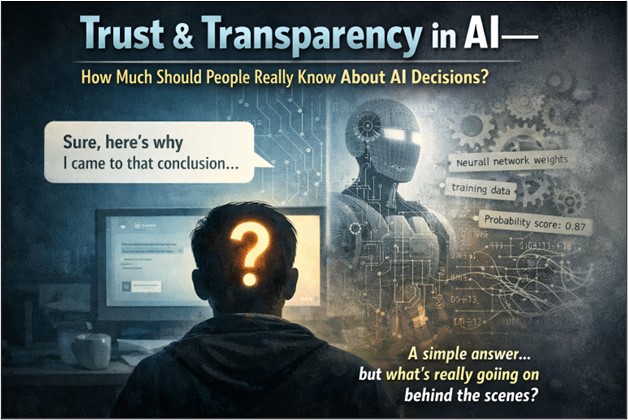
A strange thing happens when someone asks a chatbot why it gave a certain answer. The screen pauses for a moment. Then out comes a neat explanation—polished, tidy, maybe a bit too tidy.
Sounds convincing.
Sounds smart.
Still, a tiny voice in the back of the user’s head whispers, “Okay… but how did it actually decide that?”
That little moment of doubt is where the whole trust issue around artificial intelligence starts to wobble.
These days AI sits everywhere. Customer service chats. Job application filters.
Credit scoring tools. Even medical suggestions in hospitals. The tech world talks about these systems like they’re brilliant assistants quietly humming in the background. Which is true, mostly. But people relying on them often have no clue what’s happening behind the curtain.
This raises a tricky question. How much should users really know about the way AI reaches a decision?
The Black Box Problem
Ask most developers and they will admit something quietly uncomfortable. A lot of modern AI works like a black box.
Simple description, but a wildly complicated reality.
Machine learning models—especially deep neural networks—can process millions, sometimes billions, of parameters. Even the engineers who built them sometimes struggle to explain exactly why the model leaned one way instead of another. It’s a bit like asking someone to explain why a human brain suddenly remembered a song from 2004 after hearing two random notes.
Is it possible?
Maybe…. easy?
Not really.
Still, when AI decisions affect people’s lives, the mystery stops being charming and starts feeling unsettling. Imagine getting rejected for a loan, a job, or an insurance policy because “the algorithm said so.” No explanation, just a digital shrug.
Most people wouldn’t be thrilled with that setup.
People Don’t Expect Full Math Lessons.
Here’s the funny part. Users usually don’t want the full technical breakdown. Nobody’s asking for a lecture on gradient descent or training weights over coffee. That stuff makes most eyes glaze over within seconds. What people actually want is something simpler—clarity.
Why was this decision made?
What factors mattered?
Could the result change if different information showed up?
Those questions feel reasonable. They’re the same questions someone might ask a doctor, a banker, or a hiring manager. Humans explain their reasoning all the time.
Sometimes badly.
Sometimes vaguely.
Still, the explanation exists.
AI systems, oddly enough, often skip that part.
Transparency Builds Trust Slowly
Trust in technology behaves a bit like trust between people. It doesn’t appear overnight. People trusted GPS only after years of watching it guide them correctly. The first few times someone followed Google Maps down a weird side street, there was definitely hesitation. Maybe a muttered “This better work.”
AI faces the same test.
When companies explain what their systems are doing, even at a basic level, users relax a little. Not fully. Just enough to keep using the tools. Transparency doesn’t need to reveal every line of code. That would be chaos anyway. But sharing the logic behind decisions goes a long way.
For example, if an AI hiring system explains that it evaluates work experience, skills listed in resumes, and certain test results, people can at least see the playing field. It stops feeling like an invisible judge hiding in a dark room somewhere inside a server rack.
The Problem with “Trust Us”
Some tech companies still lean heavily on a classic strategy—trust us, we know what we’re doing. That approach worked better ten years ago. Today is a different case.
People have watched algorithms spread misinformation, recommend questionable content, and occasionally make wildly biased decisions. News stories pop up every few months describing an AI system that accidentally learned discrimination from historical data. Not exactly confidence-boosting material.
So when companies stay quiet about how their tools operate, suspicion grows fast. Silence invites speculation and speculation on the internet escalates quickly.
A Balance Between Openness and Reality
Complete transparency comes with its own complications. If every detail of an AI model becomes public, bad actors might learn how to manipulate it. Think spam filters. The moment spammers know exactly how the filter works, they start creating emails designed to slip right past it.
Companies also worry about intellectual property. Years of research and millions of dollars go into building some AI systems. So the goal probably isn’t total openness because that’s unrealistic.
Instead, many researchers talk about “explainability.” Basically, systems should provide understandable reasons for their outputs without exposing the entire internal structure. Think summaries, not blueprints.
Users get clarity. Developers keep their secrets.
Read: How User Behaviour Affects Rankings
Are Today’s AI Tools Transparent Enough?
The short answer is not really.
Some progress has happened. A few companies publish model cards explaining how their AI was trained. Others describe limitations or possible biases. Those steps help. Still, they’re often buried in documentation most people never read.
The average user interacting with an AI chatbot, recommendation engine, or automated decision tool still sees only the final result.