


5 Ways Professionals Create an Effective Brand Identity Management Plan
 Posted by
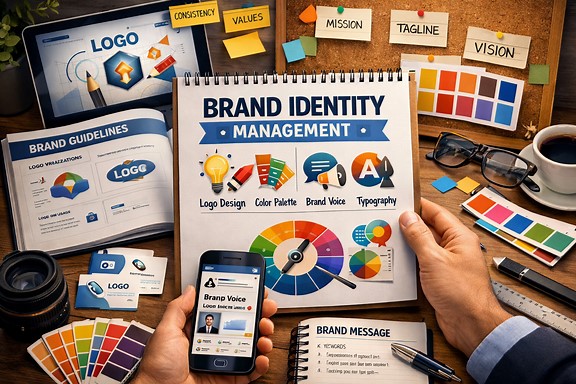
Brand identity is the way your customers perceive your business, products, and services. It is a combination of visual elements, such as logos, colors, fonts, and images, and intangible aspects, such as values, mission, vision, and personality. A strong brand identity can help you stand out from the competition, attract and retain loyal customers, and increase your revenue.
But how do you create an effective brand identity management plan?
A brand identity management plan is a document that outlines the goals, strategies, and tactics for building and maintaining your brand identity. It also defines the roles and responsibilities of your team members, the tools and resources you need, and the metrics and indicators you use to measure your progress and success.
Here are five ways professionals can create an effective brand identity management plan:
- Conduct a brand audit.
An extensive examination of your present brand identity, including its advantages, disadvantages, possibilities, and dangers, is known as a brand audit. It helps you identify the gaps between your desired and actual brand image, as well as the areas where you can improve or innovate. You can conduct a brand audit by reviewing your internal documents, such as your mission statement, vision statement, value proposition, and core values. You can also collect feedback from your external stakeholders, such as your customers, partners, suppliers, and competitors. You can use surveys, interviews, focus groups, or online reviews to gather their opinions and perceptions of your brand.
- Define your brand strategy.
A brand strategy is a long-term plan that guides your decisions and actions regarding your brand identity. It includes your brand purpose—why you exist and what you stand for; your brand positioning—how you differentiate yourself from others in the market; your brand promise—what you deliver to your customers; and your brand personality—how you communicate and interact with your audience. Your brand strategy should be aligned with your business goals and objectives, as well as reflect your customers needs and expectations.
- Create your brand’s identity elements.
Your brand identity elements are the tangible components that represent your brand visually and verbally. They include your logo, which is the symbol or icon that identifies your brand; your color palette, which is the set of colors that evoke certain emotions and associations; your typography, which is the style and size of fonts that convey your tone and voice; your imagery, which is the photos, illustrations, icons, or graphics that support your message; and your tagline or slogan, which is a catchy phrase that summarizes your value proposition or mission.
Your brand identity elements should be consistent across all your touchpoints and channels, such as your website, social media platforms, marketing materials, packaging, signage, etc.
- Implement your brand identity guidelines.
Your brand identity guidelines are a set of rules and standards that ensure the proper and consistent use of your brand identity elements. They specify how to apply your logo, color palette, typography, imagery, tagline, or slogan in different situations and contexts. They also define the dos and don’ts of using your brand identity elements to avoid confusion or dilution. Your brand identity guidelines should be clear, detailed, and accessible to everyone who works with or represents your brand.
- Monitor and evaluate brand identity performance.
Your brand identity performance is the degree to which you achieve your desired outcomes and results from implementing your brand identity management plan. It indicates how well you communicate and deliver your brand promise to your customers and how they respond to it. You can monitor and evaluate your brand identity’s performance by using various metrics and indicators, such as
- Brand awareness
- Brand loyalty
- Brand equity
- Brand recall
Closing thoughts
From the aforementioned, it becomes clear that creating a brand identity and its management is a job suited for professionals.