


AI Content vs. Thought Leadership: Why Expertise Still Matters
 Posted by
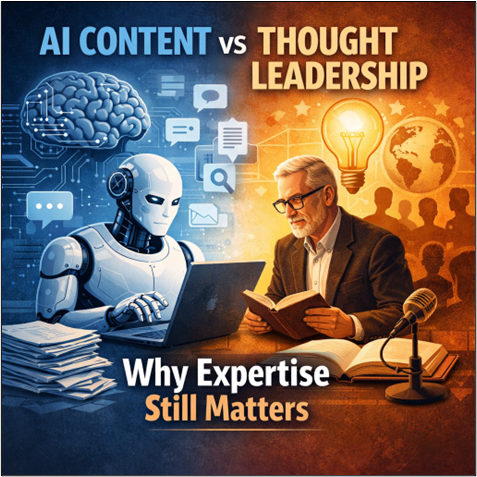
Artificial intelligence has become a permanent fixture in digital marketing workflows. Drafts appear instantly. SEO suggestions surface automatically. Personalization scales with little friction. Tools like ChatGPT can produce ad copy, landing page outlines, or campaign ideas in seconds, shifting marketers away from execution and toward planning.
On paper, this looks like progress.
Time is saved.
Output multiples.
Yet speed carries a hidden cost. When ideas are cheap, discernment weakens. Teams find themselves drowning in possibilities rather than moving forward with conviction. This phenomenon, often described as “idea inflation,” has real consequences.
By early 2025, Gallup reported employee engagement at just 31%, a ten-year low. Many organizations were producing more content than ever while feeling less connected to the work itself. For students entering marketing, the message is blunt—volume without judgment does not build brands but rather blurs them.
AI excels at generating options, but it does not decide which option matters. Without a clear editorial spine, automation turns strategy into noise. Brands publish more but say less. Audiences sense this quickly.
Attention thins and trust erodes.
When Scale Replaces Substance
The marketing industry’s embrace of AI reflects genuine pressure. Algorithms reward freshness. Platforms demand constant updates, and budgets tighten. In this environment, AI feels like relief. According to 2025 surveys, over half of U.S. marketers rely on generative tools for copy and ideation. The broader AI in the marketing sector is growing at a rapid pace, fueled by promises of efficiency.
But efficiency is not the same as influence. AI systems remix existing patterns. When fed the same prompts, they return similar structures, tones, and conclusions. Over time, this creates sameness. Content begins to read as interchangeable, especially in B2B, where awareness-stage material is increasingly summarized by large language models before a human ever visits a website.
This is the paradox. AI helps brands speak more often, but it rarely helps them sound distinct. When every competitor uses similar tools, differentiation becomes harder, not easier. Students who equate productivity with impact risk learning the wrong lesson early.
Why Expertise Still Drives Thought Leadership
Thought leadership occupies a different tier altogether. It is not about publishing frequently. It is about being referenced, trusted, and remembered. True thought leadership positions a brand or individual as someone worth listening to before a purchase decision is made.
This is where human expertise remains irreplaceable. Experts bring lived experience, pattern recognition shaped by failure, and an intuitive grasp of what matters next. AI can summarize trends, but it cannot anticipate inflection points grounded in judgment. It can mimic empathy, but it does not carry accountability.
In 2025, multiple industry reports showed that expert-led content consistently outperformed AI-only material on engagement and credibility. The reason is simple. Readers are not just consuming information. They are assessing authority. In an environment where buyers increasingly ask AI tools for recommendations or summaries, only content rooted in genuine insight tends to be cited or trusted.
Thought leadership also thrives on specificity. Vague advice travels poorly. Concrete perspectives travel far. This specificity usually comes from practitioners—people who have solved problems, navigated constraints, and formed opinions the hard way. AI can assist in structuring those insights, but it cannot originate them.
The Trust Factor in an AI-Summarized World
As AI-driven summaries become the first point of contact for many users, the bar for credibility rises. If a piece is shallow, it disappears into the background. If it offers a clear point of view, it survives compression.
Search engines reinforce this shift. Ranking systems increasingly reward experience, expertise, authoritativeness, and trustworthiness. Content that feels assembled rather than authored struggles to compete, especially in regulated or high-stakes sectors. Errors, even minor ones, carry outsized consequences.
For marketers, this changes the goal. The aim is no longer to publish the most content but to publish the most quotable content. That requires human oversight, original framing, and a willingness to say something slightly uncomfortable or new.
Using AI With a Human Mind
The most effective teams are not rejecting AI. They are containing it. AI handles research synthesis, competitive scans, early drafts, and variant testing. Humans handle direction, tone, and final judgment. This division of labor preserves energy without surrendering authorship.
Practitioners often describe “taste” as the emerging moat. Taste is the ability to choose what resonates and discard what does not. It cannot be automated easily. It is built through exposure, feedback, and reflection. Students who develop taste early—by studying audiences, not just tools—gain an advantage AI cannot erase.
Conclusion
AI lowers barriers. It makes you feel productive quickly. But long-term relevance will not belong to those who generate the most content. It will belong to those who develop judgment. Learn the tools, but do not outsource thinking. Collaborate with subject-matter experts whenever possible. Spend more time understanding audiences than prompting systems. Treat AI as an accelerator, not a compass.