

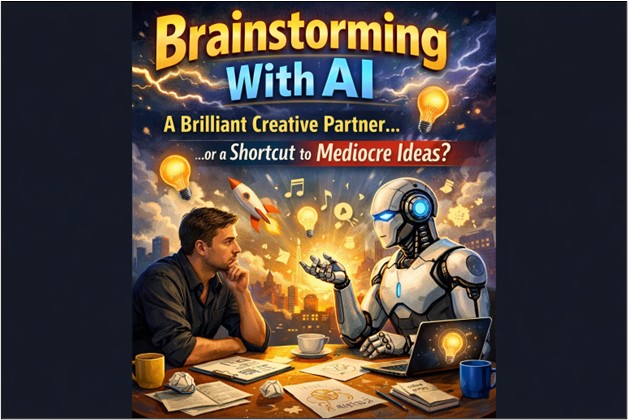
Brainstorming With AI: A Brilliant Creative Partner… or a Shortcut to Mediocre Ideas?
 Posted by
Someone on a marketing team once joked that brainstorming sessions used to involve sticky notes, cold coffee, and one overly confident guy pitching terrible taglines for thirty minutes straight.
Now?
A laptop opens, someone types a prompt into Copilot or ChatGPT, and boom—twenty ideas appear before anyone finishes their coffee.
Convenient, fast, and slightly suspicious.
Because while AI brainstorming tools can feel like a turbo button for creativity, there’s a quiet debate happening behind the scenes. Are these tools helping people think better or slowly nudging everyone toward the same kinds of ideas?
Turns out the answer sits somewhere in the messy middle.
Why Teams Are Turning to AI for Brainstorming
Deadlines don’t care about writer’s block. Marketing calendars keep moving, blog posts still need publishing and someone always wants “five fresh campaign ideas by tomorrow morning.” That’s where tools like Copilot jump in.
Instead of staring at a blank document hoping inspiration magically appears, a writer can type something simple—“Give ten ways to promote a new productivity app”—and instantly get a stack of suggestions. Headlines, campaign hooks. maybe even a rough outline.
Microsoft actually describes Copilot as an “idea generator,” which is a fancy way of saying it helps turn fuzzy thoughts into workable starting points. A team might begin with a vague concept and let the AI spit out possibilities just to get the wheels turning.
And that sheer volume of ideas? It matters.
Brainstorming isn’t always about finding the perfect thought right away. Often it’s about momentum. The more ideas floating around, the better the odds one of them sparks something interesting.
AI is extremely good at producing that momentum.
When AI Becomes the “Sixth Person in the Room”
Some creative teams treat AI almost like another participant during brainstorming sessions. Picture a group discussing a campaign concept. Someone tosses a prompt into ChatGPT. Seconds later the tools offer twenty variations with different tones, angles, maybe a strange metaphor nobody expected.
A marketing director from the fintech company Khatabook once described AI as the “sixth person in the room.” Not the smartest voice, and maybe not the most original one either, but definitely someone throwing ideas into the pile.
Oddly enough, writing prompts for AI also force humans to clarify their own thinking. When someone types “act like a marketing strategist and suggest campaign slogans,” they’re secretly refining the brief for themselves too.
The prompt becomes a thinking exercise.
Teams notice results. Some report faster content creation, fewer creative stalls, and smoother brainstorming sessions because AI handles the repetitive ideation stuff. Basically, the robot keeps the conversation moving.
The Catch: AI Loves Average Ideas
Here’s where things get a little weird. AI doesn’t actually “invent” ideas the way humans do.
It studies patterns from huge piles of data and depicts combinations that sound convincing. Which means it’s excellent at remixing familiar concepts.
A writer once joked that AI feels like the world’s most enthusiastic remix DJ—always blending things people already know.
Coffee plus winter flavors?
Sure.
Suddenly the machine suggests a peppermint latte mug concept.
Sounds fresh.
Yet somewhere, deep down, the idea probably came from patterns already floating around the internet. Some researchers call AI a “technology of averages”; it spots common trends and leans toward responses that feel widely acceptable.
That’s useful sometimes. Safe ideas can be practical. But “safe” rarely means “groundbreaking.”
When Creativity Starts to Look the Same
Researchers have actually tested what happens when people brainstorm with AI. One study published in Science Advances asked writers to create short stories with help from AI tools. Individually, the stories often scored higher for creativity and enjoyment compared to stories written alone. This sounds like a win.
But something else showed up in the data. The stories became more similar to each other.
In other words, AI helped each writer improve their own work, yet the overall variety of stories shrank. Writers unknowingly drifted toward the same patterns.
That creates a strange social dilemma. Everyone benefits individually, but the collective pool of ideas becomes narrower.
For industries that rely on bold thinking—advertising, entertainment, and design—that trend feels a bit unsettling.
Why Humans Still Beat AI at Wild Ideas
The reason is simple, honestly. Humans carry messy personal experiences, such as childhood memories and random cultural references. Weird associations that appear out of nowhere. AI doesn’t have those things.
It doesn’t suddenly remember a childhood smell that inspires a story. It doesn’t get emotional about a song’s lyrics and spins that feeling into a campaign idea. Most AI outputs stay inside familiar boundaries unless someone deliberately pushes the system toward unusual directions.
Most AI outputs stay inside familiar boundaries unless someone deliberately pushes the system toward unusual directions.
Even advanced models like GPT-4 perform extremely well on average creativity tasks, yet they rarely outshine the most imaginative human thinkers when it comes to completely unexpected ideas.
Those big leaps still belong to people.